

Charlie Munger had a simple rule for investing, borrowed from a fisherman friend:
“The first rule of fishing is to fish where the fish are.”

It’s simple to understand, but it can be hard in practice.
Investing is like fishing in an ocean.
There are roughly 60,000 publicly traded stocks in the world.
For dividend investors a great place to go fishing is in the pool of Dividend Aristocrats.
These are S&P 500 companies that have raised their dividends for at least 25 consecutive years.
There's only 68 of them.
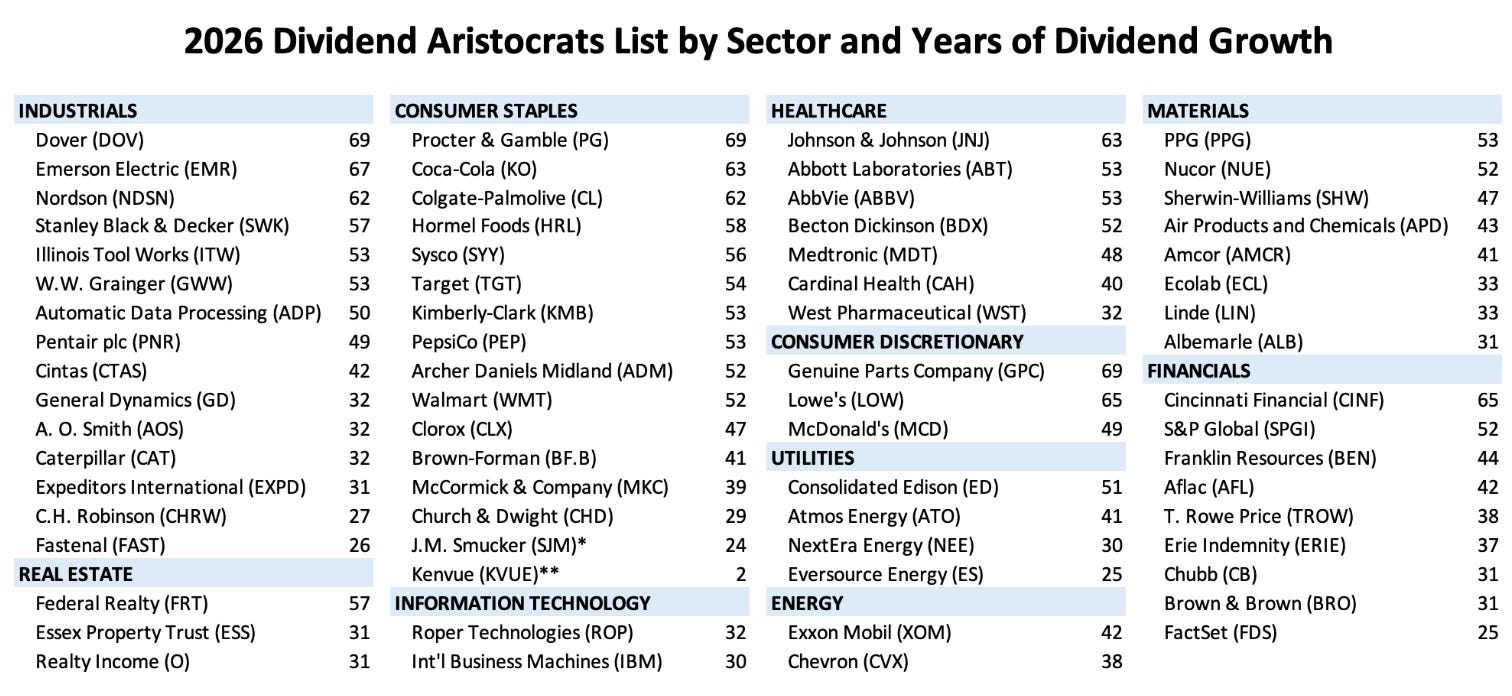
If you’re wondering why, think about what a business has to survive to pull that off.
Generating enough cash through dot-com busts, the 2008 financial crisis, pandemics, inflation spikes, and interest rate shocks to send shareholders a bigger paycheck every single year.
That track record doesn’t guarantee future success, of course.
Past winners can and do stumble.
But as a starting place, the Aristocrats have already filtered out the vast majority of companies.
Two Simple Filters
To make fishing in this pond even easier, we already maintain two live spreadsheets for Partners:
The Yield Tracker: Sorting the Aristocrats by their current dividend yield.
The 52-Week Low Tracker: Sorting them by how close they are trading to their lowest price of the past year.
With a few clicks, we can see which Aristocrats Mr. Market is depressed about.
Sometimes, a stock is on that list because a great business is having temporary problems.
Other times, it’s there for a very good reason, and it deserves the cheap price.
That brings me to one of the most important parts of my investing process that I don’t write a lot about.
Saying “No” Quickly
When you read Compounding Dividends, you mostly see what passed my process - the deep dives, the portfolio updates, and the companies we decide to buy.
What you don’t see is the pile of ideas that I’ve said ‘no’ to and passed on.
In investing, your default answer to almost every idea should be ‘no.’
Berkshire Hathaway’s insurance chief, Ajit Jain, has one of my favorite quotes about this.

Here's what he says he tells new hires:
“Your job is to say no. You will get bombarded with deals day in and day out, but your base case is just say no. Every now and then, you will come across a deal that will hit you with a 2x4 and it’ll be screaming money.”
That’s how you should think about investing.
Here’s why:
Your time is valuable. You can’t analyze every stock. That means you should try to kill every idea as fast as possible. Ask three quick questions: Do I understand how it makes money? Does it interest me? Can I make an educated guess about where it will be in 10 years? If the answer to any of those is ‘no,’ move on immediately.
Returns follow Power Laws. Investing results aren’t evenly distributed. Warren Buffett has said Berkshire’s success comes down to roughly 12 truly great decisions out of about 300. Research from Hendrik Bessembinder found that just 86 stocks accounted for half of all U.S. stock market wealth creation over a 90-year span.Extraordinary results come from a tiny minority of your decisions.
Activity is not productivity. In most jobs, doing more leads to better results. In investing, doing more usually just leads to more mistakes. Saying ‘no’ to everything but the best ideas protects your time, your capital, and your conviction, so you’re ready to swing when the rare deal that screams money shows up.
A New Experiment: The Aristocrat Breakdown
Because saying ‘no’ is 90% of the job, I want to show you how it actually looks in practice.
Here is what I’m thinking:
We’re going to take a handful of Dividend Aristocrats from our High Yield and 52-Week Low screens.
Then we’ll try to kill them quickly.
I’ll walk you through what I’m looking at, the red flags, and why a ‘cheap’ Aristocrat might get an instant pass.
And if one of them survives and looks genuinely interesting?
Then we’ll dig deeper.
Consider this a test run.
If you enjoy seeing the behind-the-scenes process, both the quick passes, and the companies that make it through the first pass, we can turn this into a regular series.
This Saturday, we’ll open up the spreadsheets, pull the first batch of names, and see how fast we can kill them.
One Dividend At A Time,
-TJ
Used sources
Interactive Brokers: Portfolio data and executing all transactions
Fiscal.ai: Financial data
Disclaimer
As a reader of Compounding Dividends, you agree with our disclaimer. You can read the full disclaimer here.
A long dividend streak can make a payout cut feel unthinkable. I’d check whether free cash flow after maintenance capex still covers the dividend.