

Most people think options are complicated, risky, and only for Wall Street traders.
Well, they are wrong.
When we use options the right way, we can buy stocks at a discount and generate some income from the shares we already own.

This is my first time writing about Options.
So I will try to keep it simple and beginner friendly.
Let’s cover some basics first.
What is an Option?
An option is a contract between two people.
It gives one person the right, but not the obligation, to buy or sell a stock at a specific price, before a specific date.
There are two types of options:
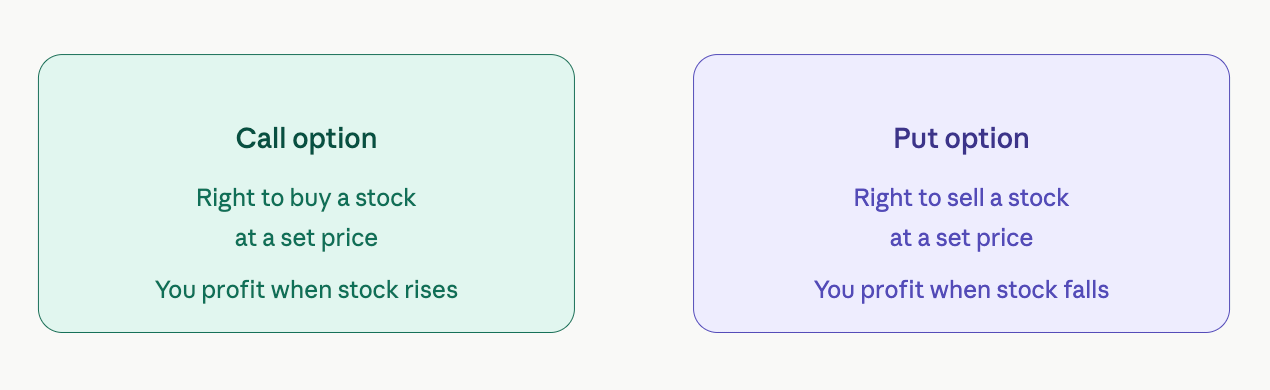
Call Option – gives the buyer the right to buy a stock at a set price
Put Option – gives the buyer the right to sell a stock at a set price
Every option contract covers 100 shares of a stock.
There are a few key terms you need to understand before going further.
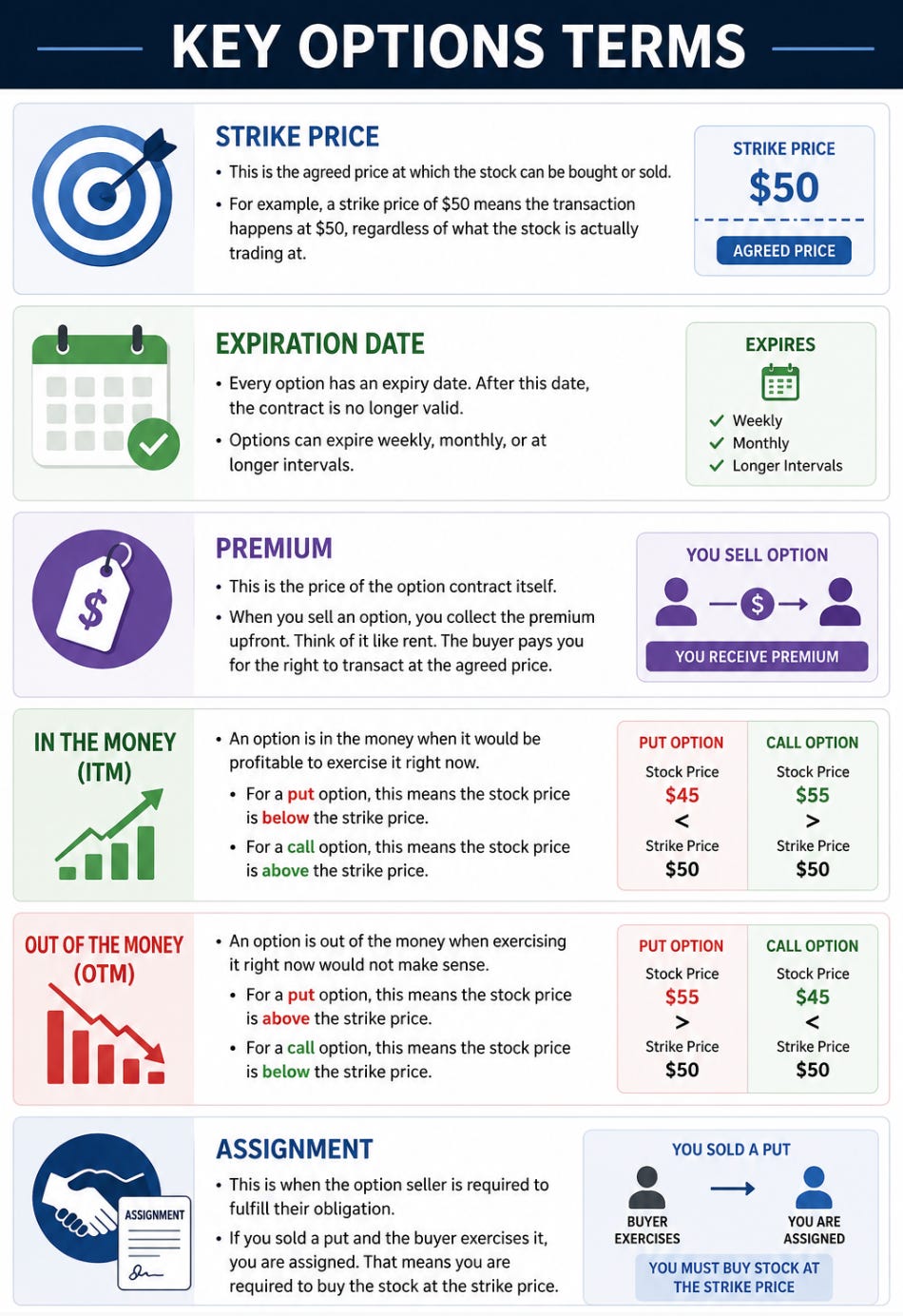
Key Terms to Know
This visual covers the important key terms:
Beginner Options Strategies
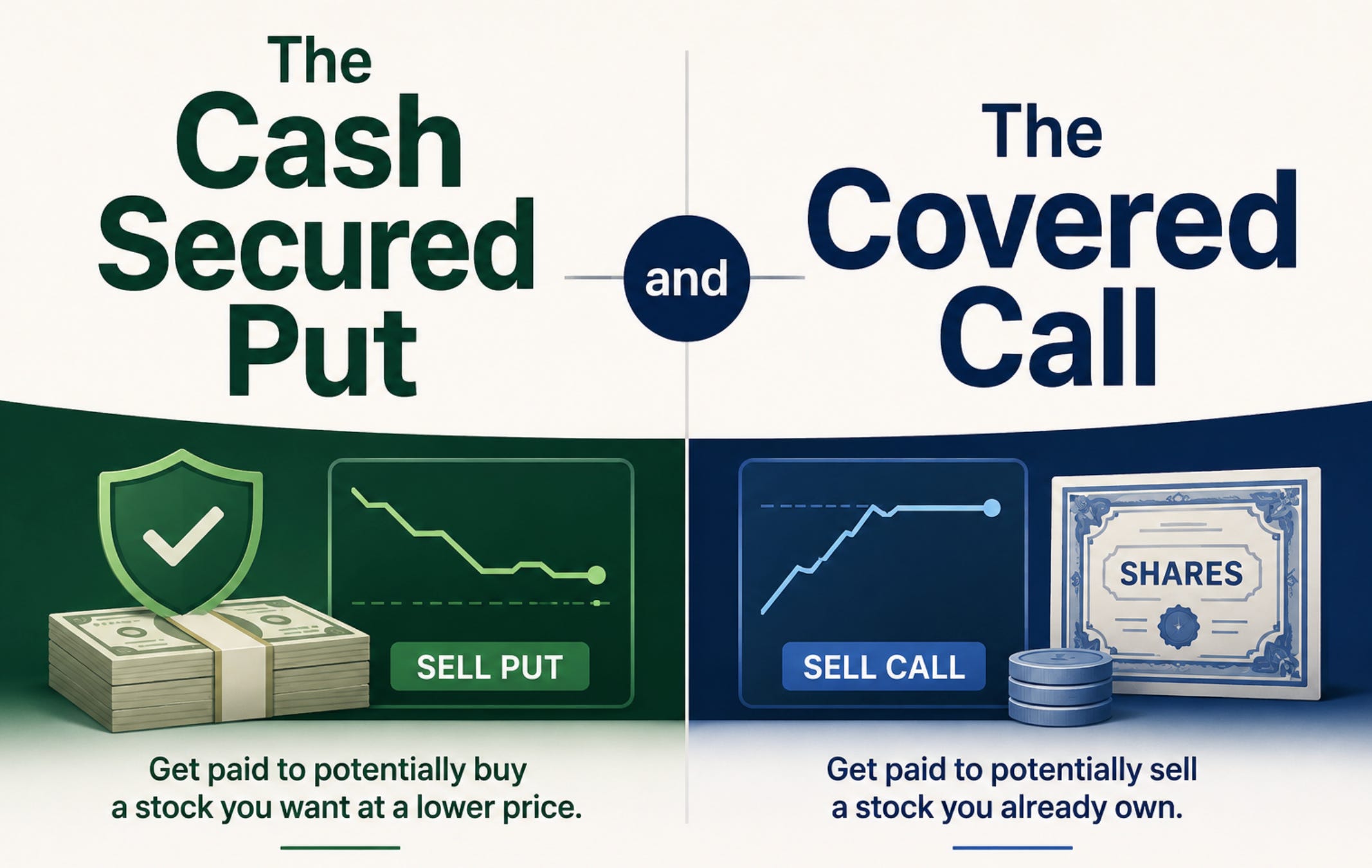
There are two options strategies that every beginner should know.
The Cash Secured Put
The Covered Call
These two strategies are not about speculation or gambling on stock prices.
They are about generating consistent income, buying stocks at prices you are comfortable with, and getting paid while you wait.
Most people buy options to gamble on the direction of a stock price.
We’re not going to be doing that.
We’ll be selling the options to the gamblers, and collecting their premiums.
Now, let’s understand these two strategies more clearly.
Strategy One: The Cash Secured Put
What Is a Cash Secured Put?
A Cash Secured Put means you sell a put option on a stock you would be happy to own.
In exchange, you collect a premium upfront.
The word cash secured means you have enough cash set aside to actually buy 100 shares of the stock if required.
How Does It Work?
When you sell a put option, you are making a promise to another investor.
You are saying:
“If this stock falls to my strike price, I am happy to buy it from you at that price.”
In return, the buyer pays you a premium immediately.
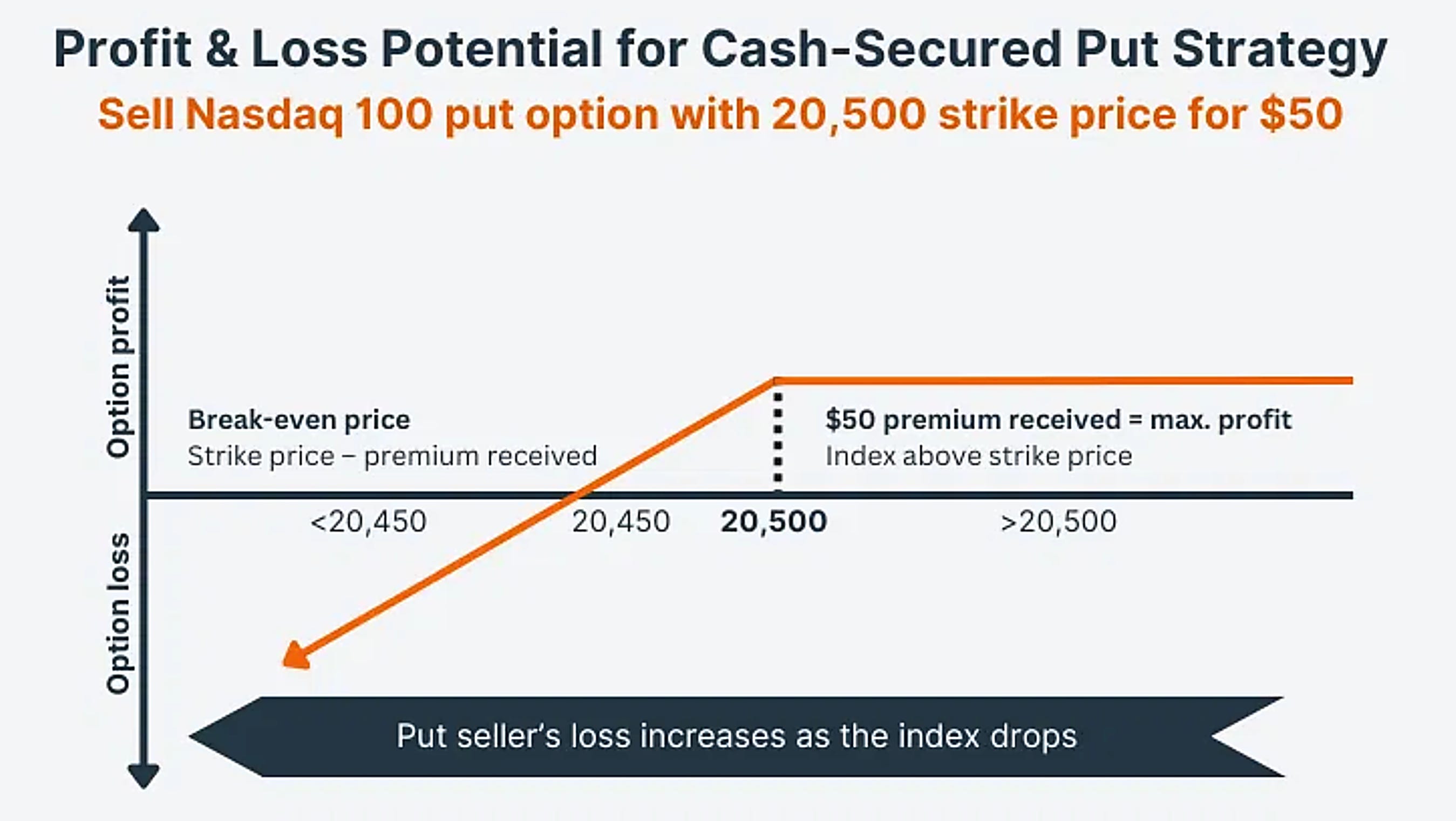
Once you sell the put, there are two possible outcomes:
The stock stays above your strike price
The option expires worthless. The buyer does not need to sell to you. You keep the premium as pure profit. No shares change handsThe stock falls to or below your strike price
The buyer exercises the option. You buy 100 shares at the strike price, and you keep the premium, reducing your effective cost
Let’s use an example:
Simple Example
Imagine a stock called ABC is trading at $100.
You like ABC and would be happy to own it at $90.
You sell a put option with:
Strike price: $90
Expiration: 30 days from now
Premium collected: $2 per share = $200 total (remember, one contract = 100 shares)
You set aside $9,000 in cash, which is enough to buy 100 shares at $90 if needed.
Scenario A: ABC stays above $90
The option expires worthless and you keep the $200 premium.
Your $9,000 cash is free to use again. That is a return of roughly 2.2% in just 30 days, without ever buying the stock
If you could do this every single month, you would make a return of more than 26% per year!
Scenario B: ABC falls to $85
You are assigned and must buy 100 shares at $90. Your actual cost is $90 minus the $2 premium = $88 per share.
You now own a stock you liked, at a price you wanted to pay.
Strategy Two: The Covered Call
What Is It?
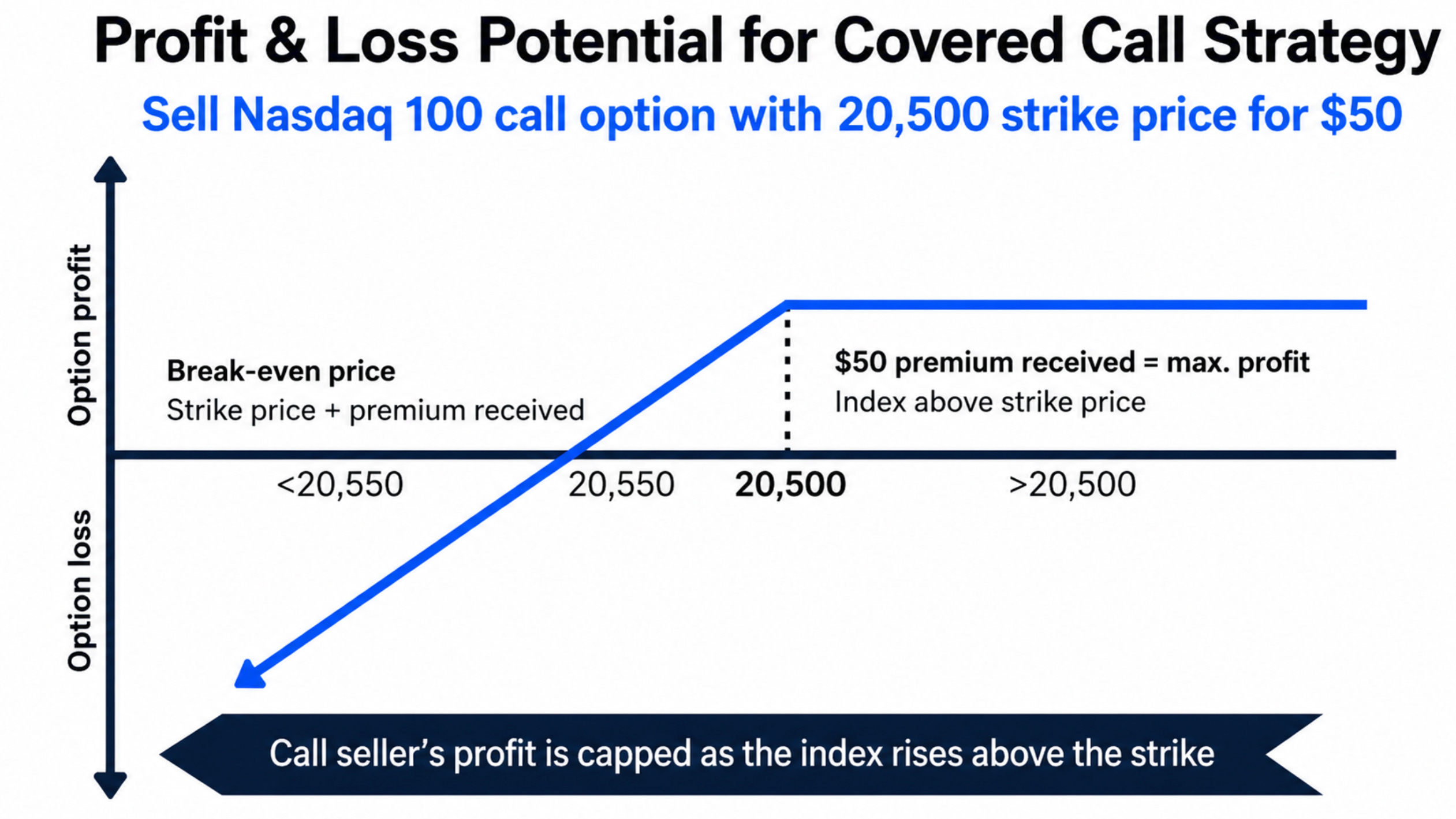
A Covered Call means you sell a call option on shares you already own.
In exchange, you collect a premium.
The word covered means you already hold the shares.
How Does It Work?
When you sell a call option, you are making a different promise to another investor.
You are saying:
“If this stock rises to my strike price, I am happy to sell my shares to you at that price.”
In return, the buyer pays you a premium immediately.
This brings us to two possible outcomes:
The stock stays below your strike price
The option expires worthless. The buyer has no reason to buy your shares at the strike price. You keep your shares and the premium.
The stock rises above your strike price
The buyer exercises the option. You sell your 100 shares at the strike price. You miss out on any gains above that price, but you still keep the premium
Let’s take an example to this understand better.
A Simple Example
You own 100 shares of ABC, currently trading at $100.
You are happy to sell those shares if they reach $110.
You sell a call option with:
Strike price: $110
Expiration: 30 days from now
Premium collected: $1.50 per share = $150 total
Scenario A: ABC stays below $110
The option expires worthless. You keep your 100 shares and pocket the $150 premium
That is extra income earned just for holding shares you already owned
Scenario B: ABC rises to $115
You are assigned and must sell your 100 shares at $110.
You miss the extra $5 per share above $110, but you still made a $10 per share gain on the stock plus the $1.50 premium. Your total gain is $11.50 per share, or $1,150
Use them together
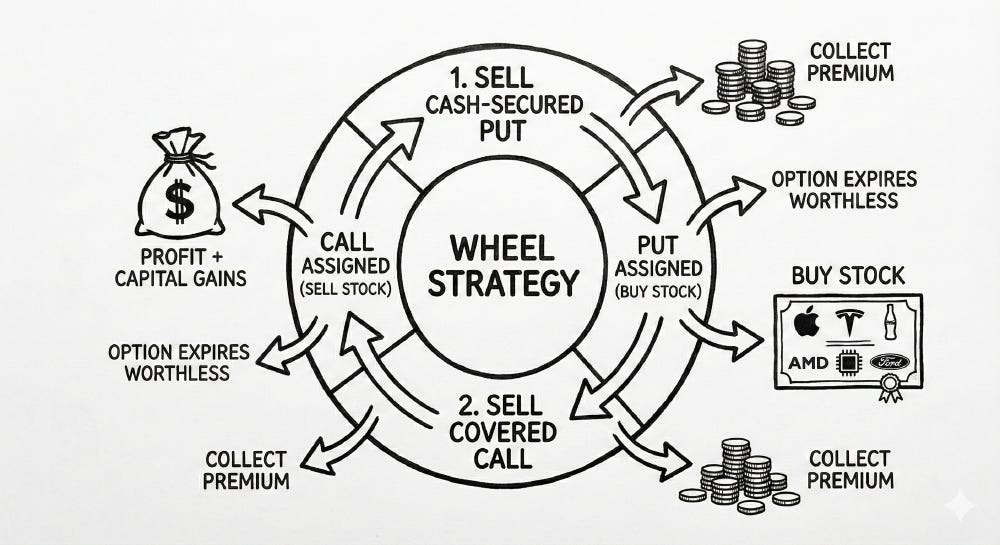
Many investors combine these two strategies, known as the Wheel Strategy.
It works in three simple steps:
Sell a Cash Secured Put on a stock you’d like to own and collect a premium. If assigned, you buy the shares
Once you own the shares, sell a Covered Call and collect another premium. If assigned, you sell the shares
Repeat the process
The goal is simple:
Get paid while waiting to buy
Get paid while holding the stock
Get paid again when you sell
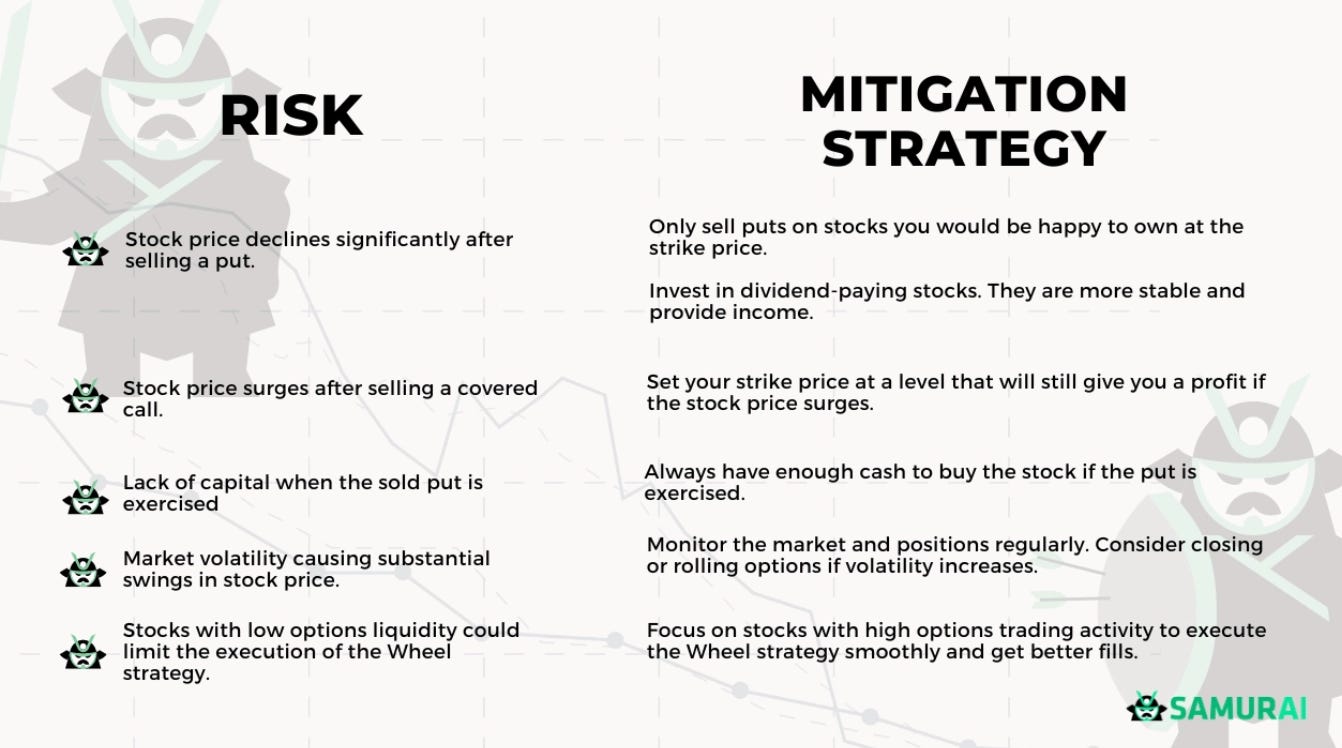
What Are the Risks?
Options so have risks.
We need to aware of them:
Cash Secured Put Risk
If the stock falls sharply and far below your strike price, you are still obligated to buy at the strike price
Your effective cost is reduced by the premium, but you could be sitting on a loss if the stock keeps falling
This is why you should only sell puts on stocks you genuinely want to own at that price. Never sell a put just for the premium on a stock you do not believe in
Covered Call Risk
If the stock rises sharply above your strike price, you are obligated to sell at the strike price. You cap your upside
For example, if you sold a call at $110 and the stock goes to $140, you must still sell at $110. You miss the extra $30 of gains
This is why covered calls work best on stocks you hold for income, or stocks trading above their intrinsic values, not stocks you expect to double or triple quickly
Don’t Gamble
The biggest risk in options trading is losing control of yourself.
To keep our trades logical and without any emotional influence, we need to follow some rules:
Only use these strategies on stocks you want to own
These are not set and forget trades. You need to be comfortable owning the stock if assigned, or selling it if called away
Choose strike prices you are genuinely happy with
Do not sell a put at $90 if you would panic seeing the stock at $90. Only sell at prices where your honest reaction is “I am fine with that”
Start with liquid, well-known stocks
Stocks with high trading volumes have tighter bid-ask spreads on options, which means better prices for you
Pay attention to earnings dates
Option premiums spike around earnings announcements. Selling options just before earnings can be tempting because of the high premium, but the risk of a large move is also much higher
Keep position sizes reasonable
Never put all your cash into a single Cash Secured Put. Spread across a few positions so one bad trade does not wipe out your gains
Conclusion
The Cash Secured Put and Covered Call are two of the most practical options strategies available to everyday investors
I think of them as getting paid to place limit orders
They are not about predicting markets or taking big risks
They are about getting paid to be patient, buying stocks you want at prices you choose, and earning extra income from shares you already hold
Together, they form a simple, repeatable cycle that can generate consistent income month after month
Options strategies have both risks with rewards
Remember that we’re not gambling, we need to be logical with our trades
That’s it for today!
One Dividend At A Time,
-TJ
Used sources
Interactive Brokers: Portfolio data and executing all transactions
Fiscal.ai: Financial data
That's been my takeaway as well. A lot of investors focus solely on dividends, but options can create cash flow while also helping define entry and exit prices. The discipline aspect is often overlooked.
Covered calls and cash-secured puts are underrated income strategies. They let you monetize time decay while staying disciplined about entry and exit prices. Great primer.