

In part 1 we talked about the increasing stress on the consumer, and how the broad index seems to be ignoring it.
But that when you look under the surface, the average individual stock is doing much more worse than the overall index.
More than 1/2 of the stocks within the S&P 500 are down 20% or more from their highs.
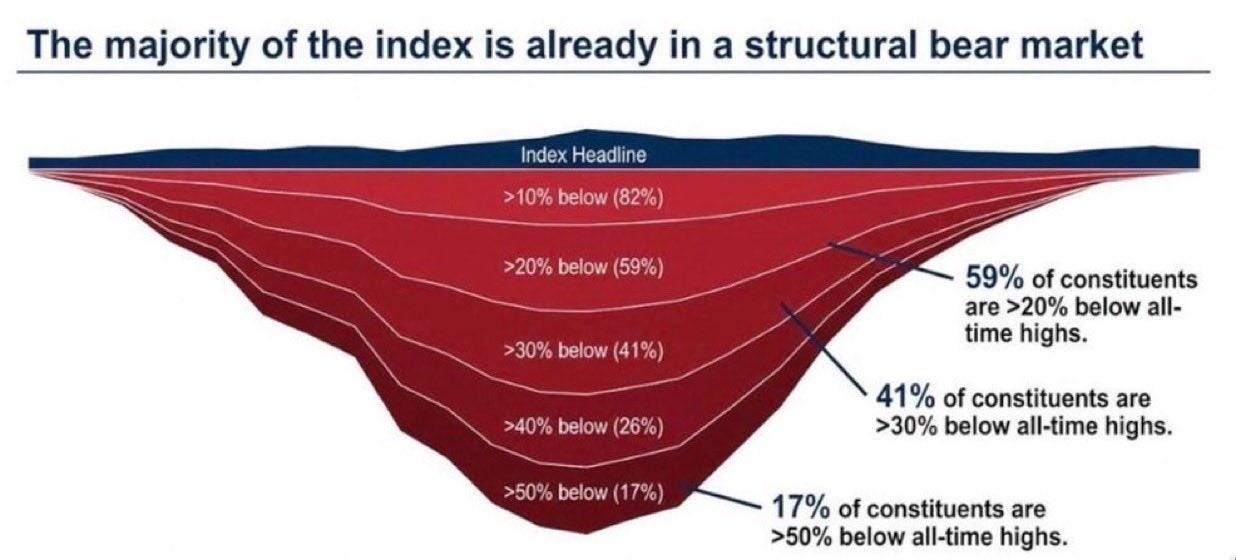
The indexes are being propped up by the AI buildout.
The spending is massive.
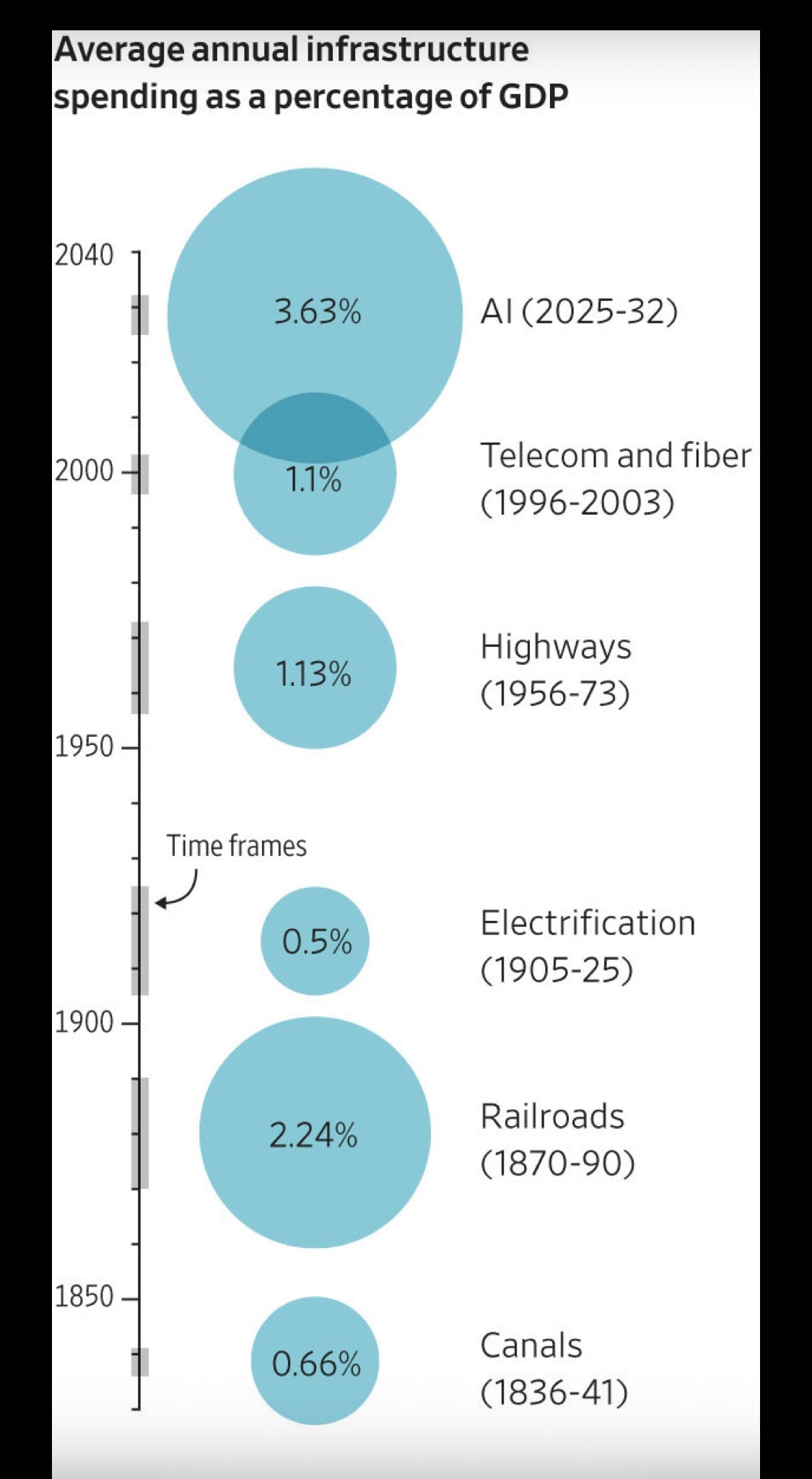
The Wall Street Journal just published an article about the spending on AI.
Between 2025 and 2032, we’re projected to spend nearly 3.7% of GDP on AI.
U.S. GDP is about $32 trillion
Over 8 years, that’s about $256 trillion
3.7% of that is $9.5 trillion on AI
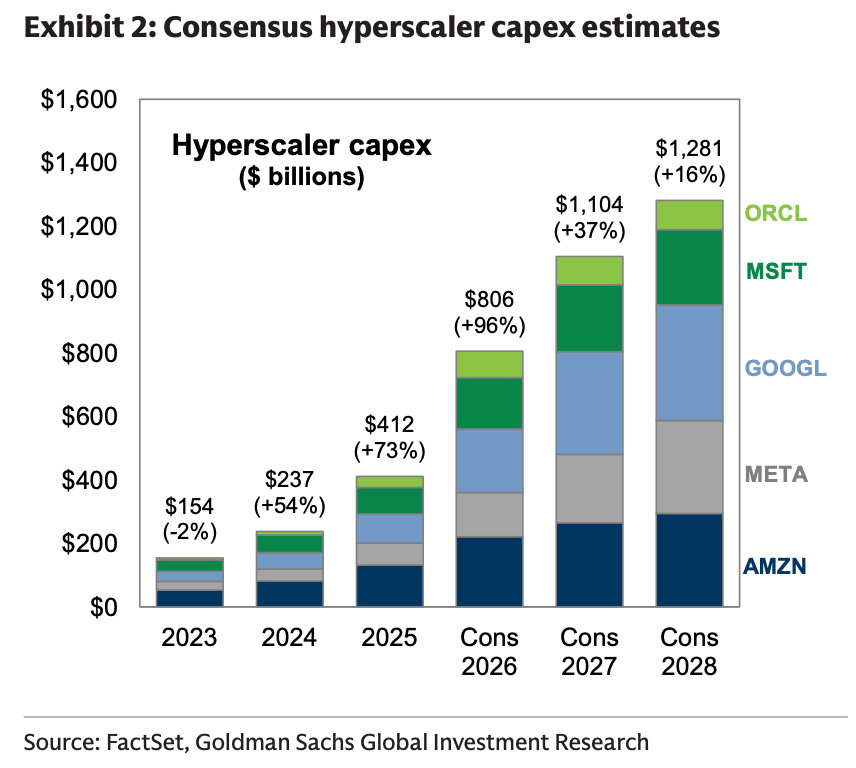
That squares pretty well with Goldman Sachs’ estimates:
We have seen this kind of thing before.
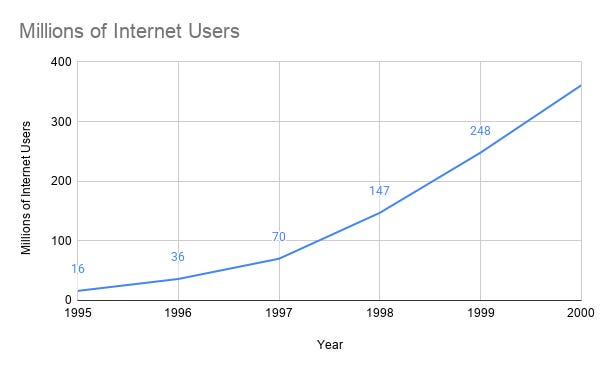
In the late 1990’s the internet was changing how people worked, shopped, communicated, and more.
The growth of internet users was astounding.
This rapid growth, and the obvious growth that would come in the future also required a massive infrastructure build out.
Telecom companies like WorldCom, Global Crossing, and Qwest laid hundreds of thousands of miles of fiber.
Equipment makers like Cisco and Lucent couldn’t keep up with the demand for switches and routers.
They ended up massively overbuilding their networks.
By 2001, 5% or less of the fiber buried in the ground was being used.
Companies like Global Crossing and Worldcom went bankrupt.
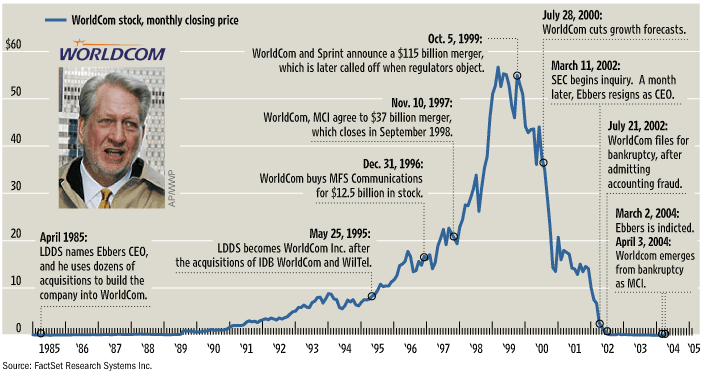
Companies like Microsoft and Cisco took a decade or more for their stock prices to recover.
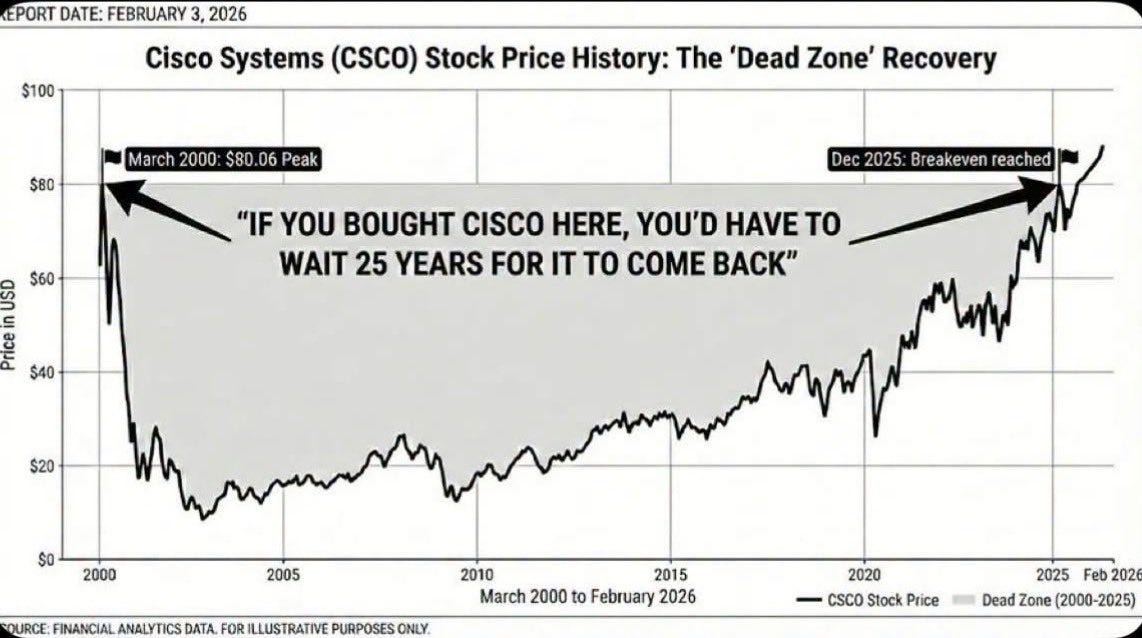
This pattern has played out in every infrastructure buildout for a new ‘disruptive’ technology.
Massive capital investment leads to overinvestment, overcapacity, and an eventual bust.

So that’s the base rate for AI - lots of spending, successful technology, losses for investors.
I think there is an important difference between today’s AI buildout and the historical parallels like the internet and railroads.
Asset Life
Railroad tracks can last 50 or 100 years.
The fiber laid in the 90’s laid in the ground and the extra capacity made things like streaming your favorite movie on Netflix possible.
The infrastructure being built out to support AI won’t last that long.
The outer shell of the data centers will be around a few decades.
But what about what’s inside?
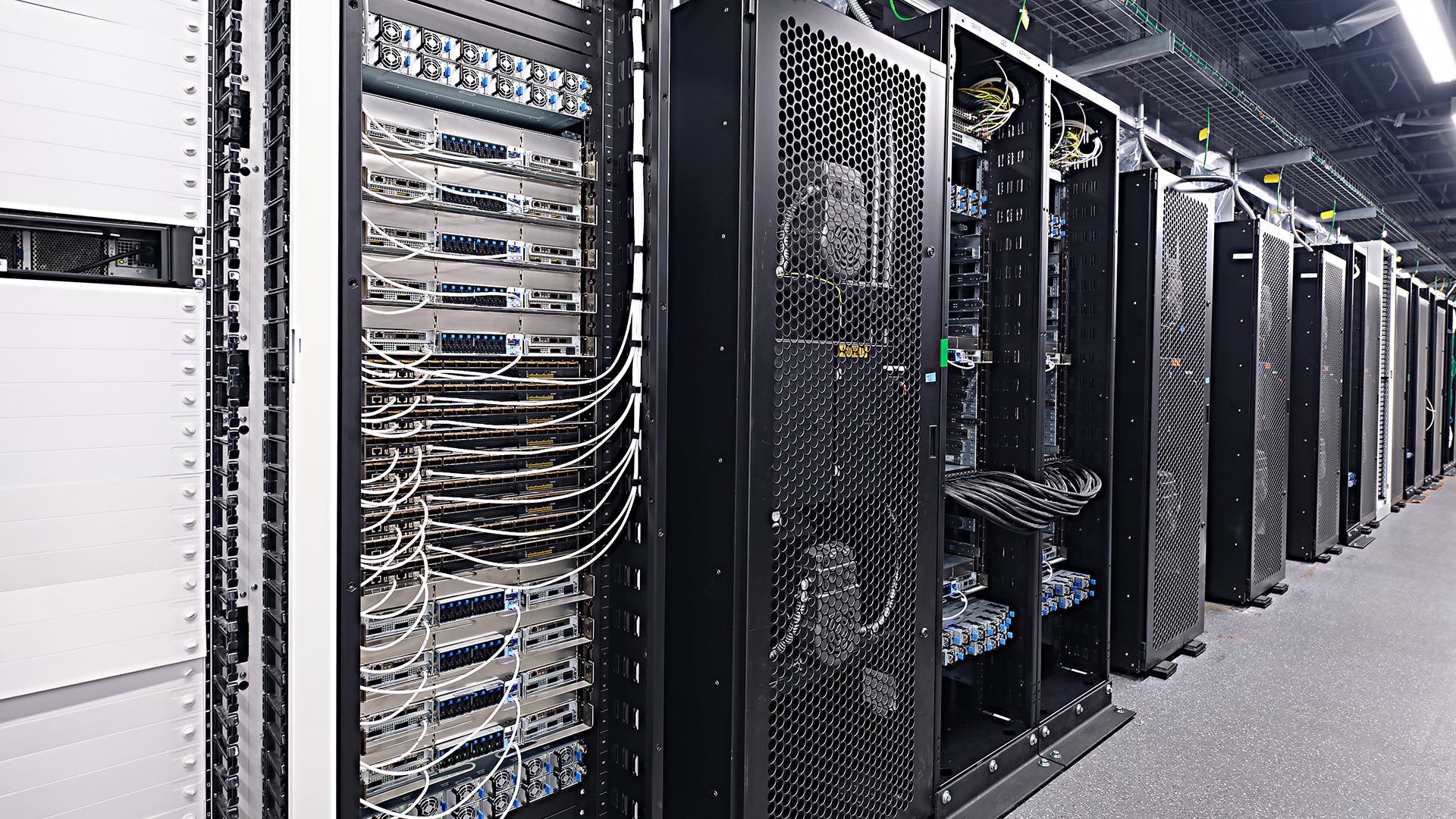
The cooling systems, power connections, etc. are all built for a specific generation of Nvidia chips.
And those chips only last so long - we’ll talk about the debate on exactly how long later.
But each generation is more powerful and more efficient.
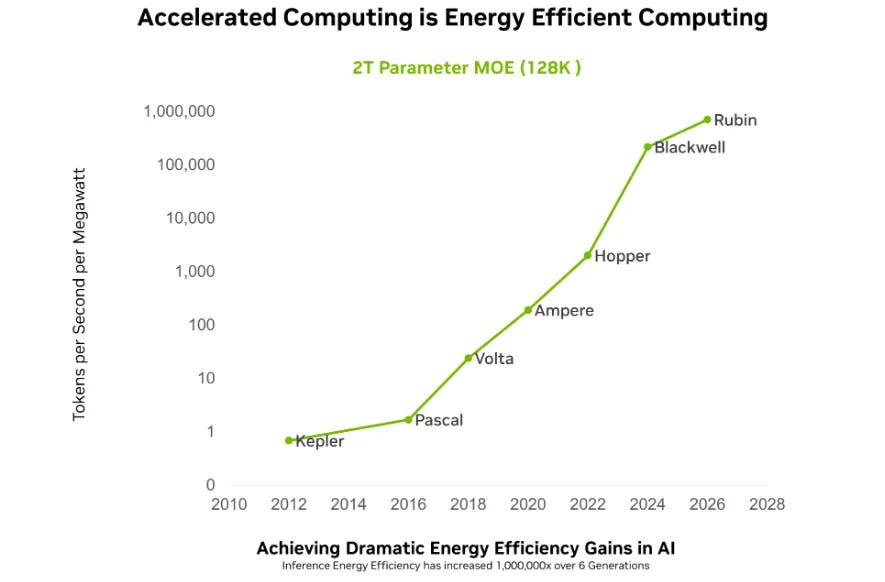
These companies won’t be able to just install the current generation of chips, and leave them in place for 20 years.
AI won’t just require a lot of capital to build out the infrastructure.
Once it’s in place, there will be a treadmill of maintenance capex that won’t go away.
Why would companies want to jump on that treadmill?
The Big Market Delusion
Aswath Damodaran is a Professor of Finance at NYU’s Stern School of Business and is widely known across the investment world as the “Dean of Valuation”.

He’s considered one of the top global experts on corporate finance, understanding market pricing, and valuing businesses.
He’s got a great framework to explain what’s going on.
He calls it the Big Market Delusion.
Transformative new markets like commercial aviation, e-commerce in 1999, online advertising in 2015, or artificial intelligence today are great candidates for this.
Everyone can see the potential, and everyone realizes the market will be gigantic.
They’re usually right - the internet and commercial aviation did change the world, e-commerce really did change how we shop.
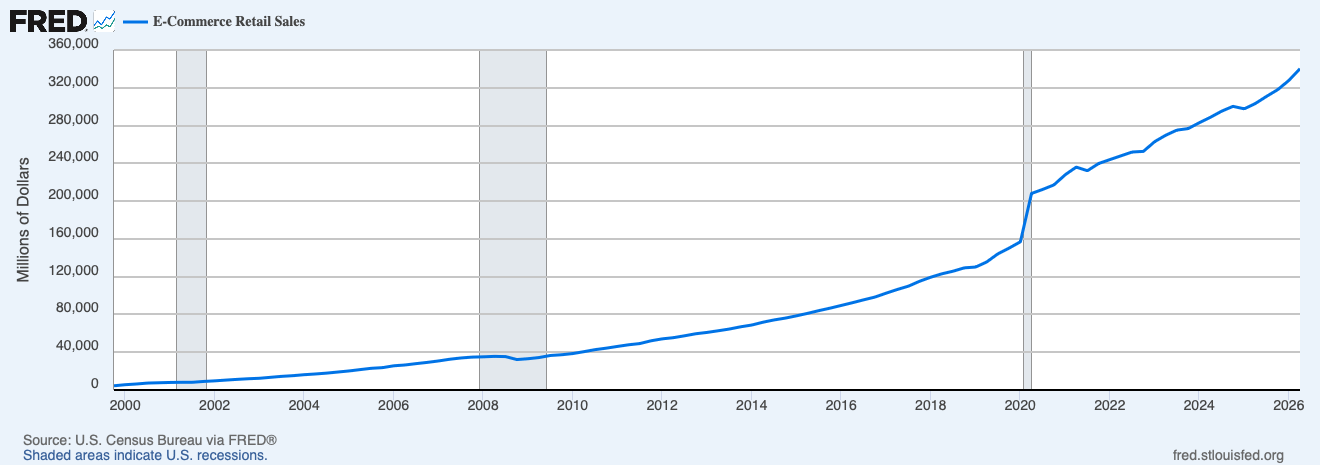
That’s not where the delusion lies, it’s in the math of the investment returns.
Here’s what happens:
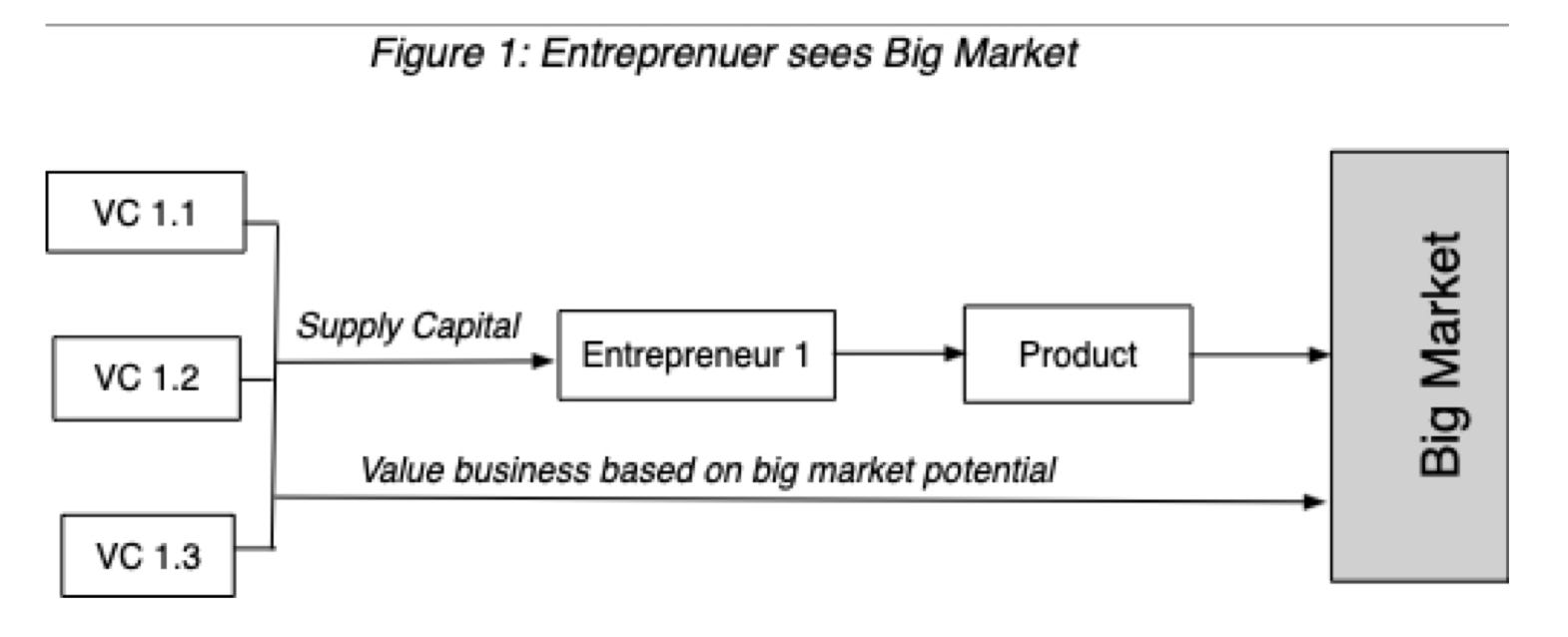
A Huge MarketAppears: Entrepreneurs and CEOs see a multi-trillion-dollar total addressable market
Everyone Thinks They’ll Win: Microsoft, Alphabet, Meta, Amazon, OpenAI, and dozens of venture-backed startups raise and deploy billions
Valuations Price in Monopoly Outcomes: Wall Street assumes each company will capture a dominant share of the market at high operating margins
When you look at each company, the picture looks like this:
But what’s really happening is this:
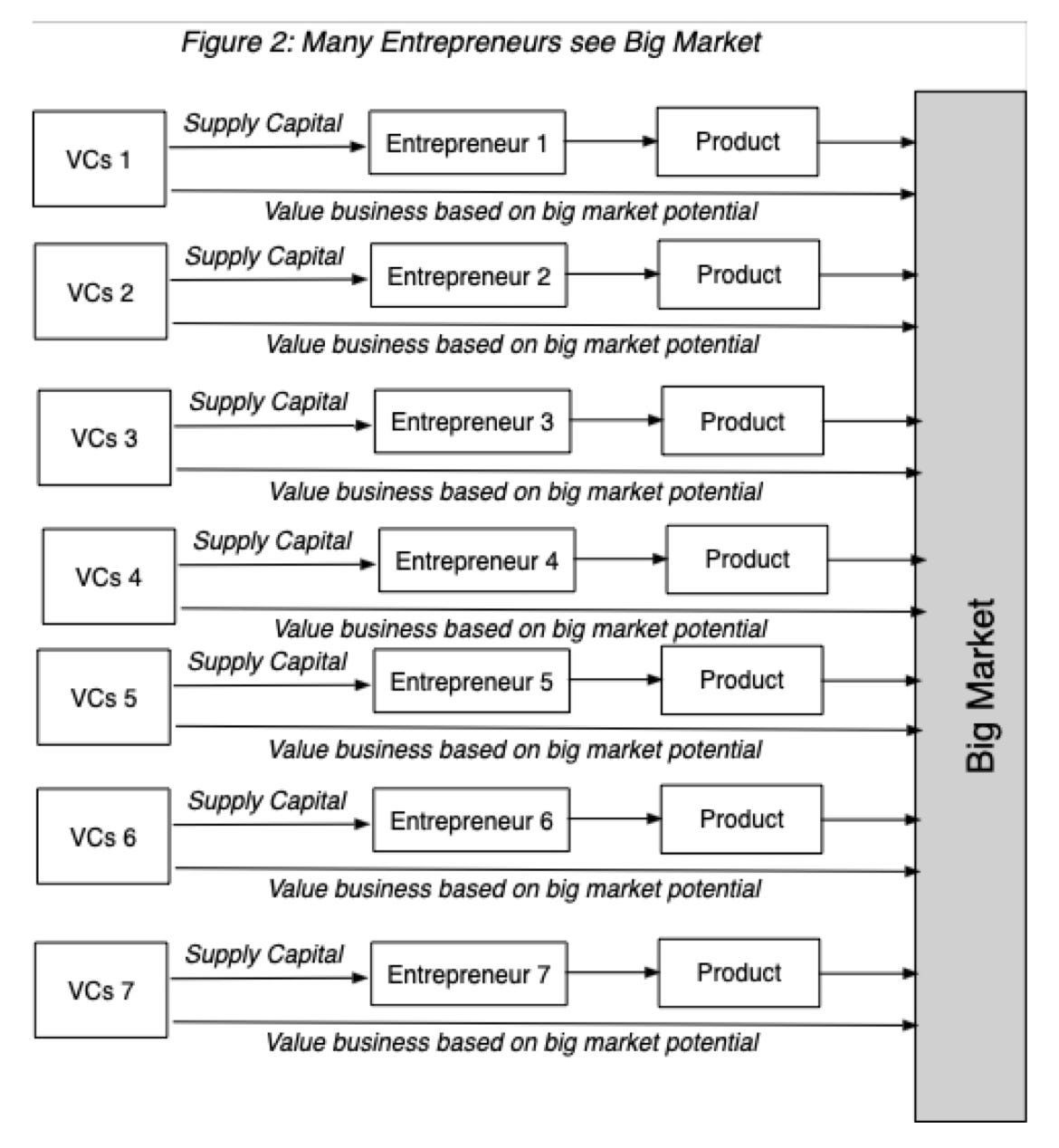
The individual story for each company sounds rational.
But collectively, they’re impossible - you can’t have 4 or 5 companies that each have 40% of the market.
So here’s what ends up happening:
Companies get overvalued based on the big market - that lets them raise a lot of capital
Excess capital leads to overinvestment - which creates overcapacity and competition
That leads to lower prices and lower margins
The Big Market Delusion makes investors confuse a great technology with a great investment.
We’re already seeing the cost of AI models dropping very quickly.
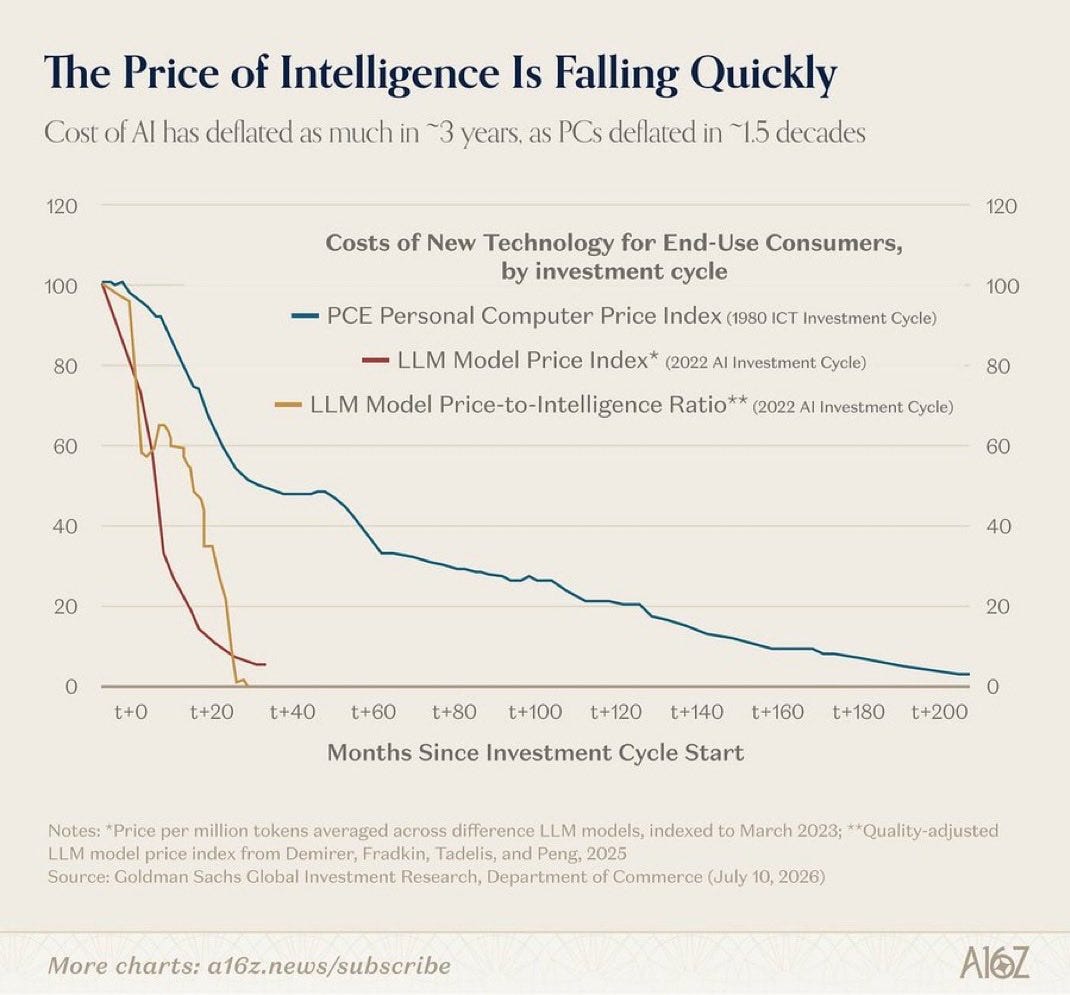
If we look at analysts expectations, we also see evidence of the Big Market Delusion.
Analysts covering the tech industry expect Big Tech’s cash flow to double to $2.4 trillion by 2028.
Ok, great, who is going to pay for it?
Presumably all that cash flow will come from those tech companies selling their tools to the rest of the economy.
Analysts covering those other industries are forecasting very slow, modest cash growth for their companies.
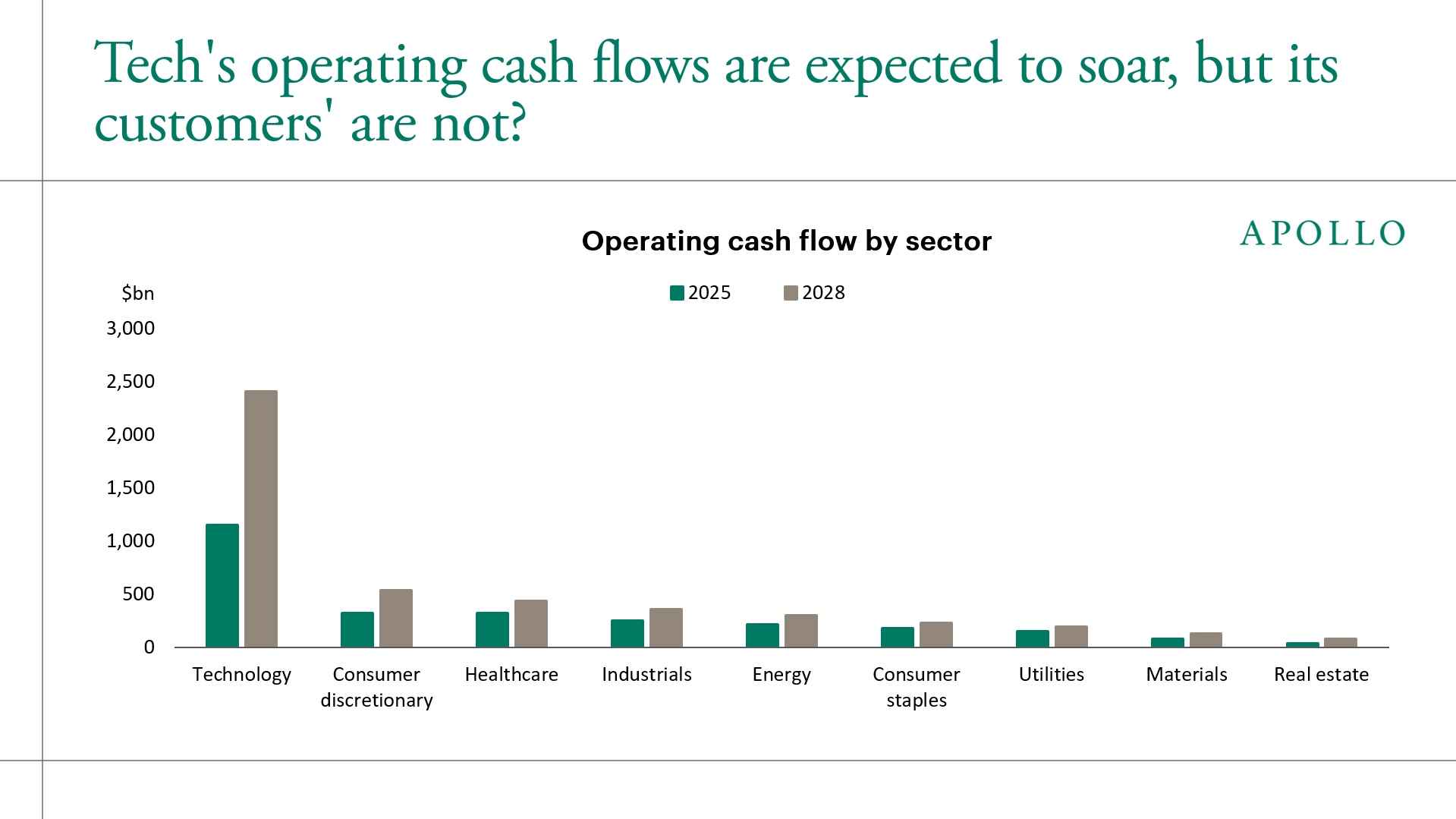
Both groups can’t be right.
Either the rest of the economy will magically find an extra $1.2 trillion to hand over to Big Tech, or the tech analysts are way too optimistic.
Depreciation and Return on Capital
The big market is clearly there for AI.
The flood of capital and huge amounts of spending are there.
Falling prices are clearly there.
What’s it going to take for AI to avoid destroying investors capital like so many other infrastructure build outs did?
To be frank, a whole lot of revenue.
Goldman Sachs thinks it would take $300 billion in AI revenue to breakeven on the 2026 and 2027 capex.
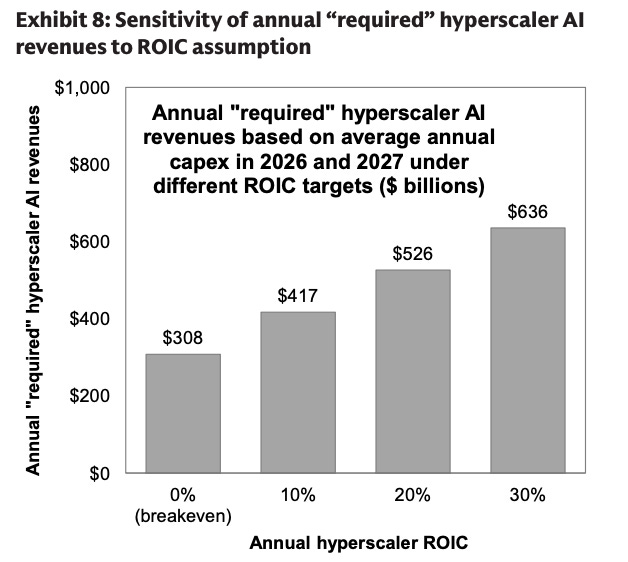
That’s just to not lose money.
To earn a reasonable return will take even more.
One huge problem that’s coming for the hyperscalers is depreciation.
All those chips, servers, and data centers will end up on the balance sheet and will need to be depreciated through the income statement.
Christopher Bloomstran did some math that shows what could be coming:
If cumulative spending hits $2.5 trillion by 2030, an 8-year blended depreciation schedule needs over $300 billion in annual non-cash depreciation expense alone
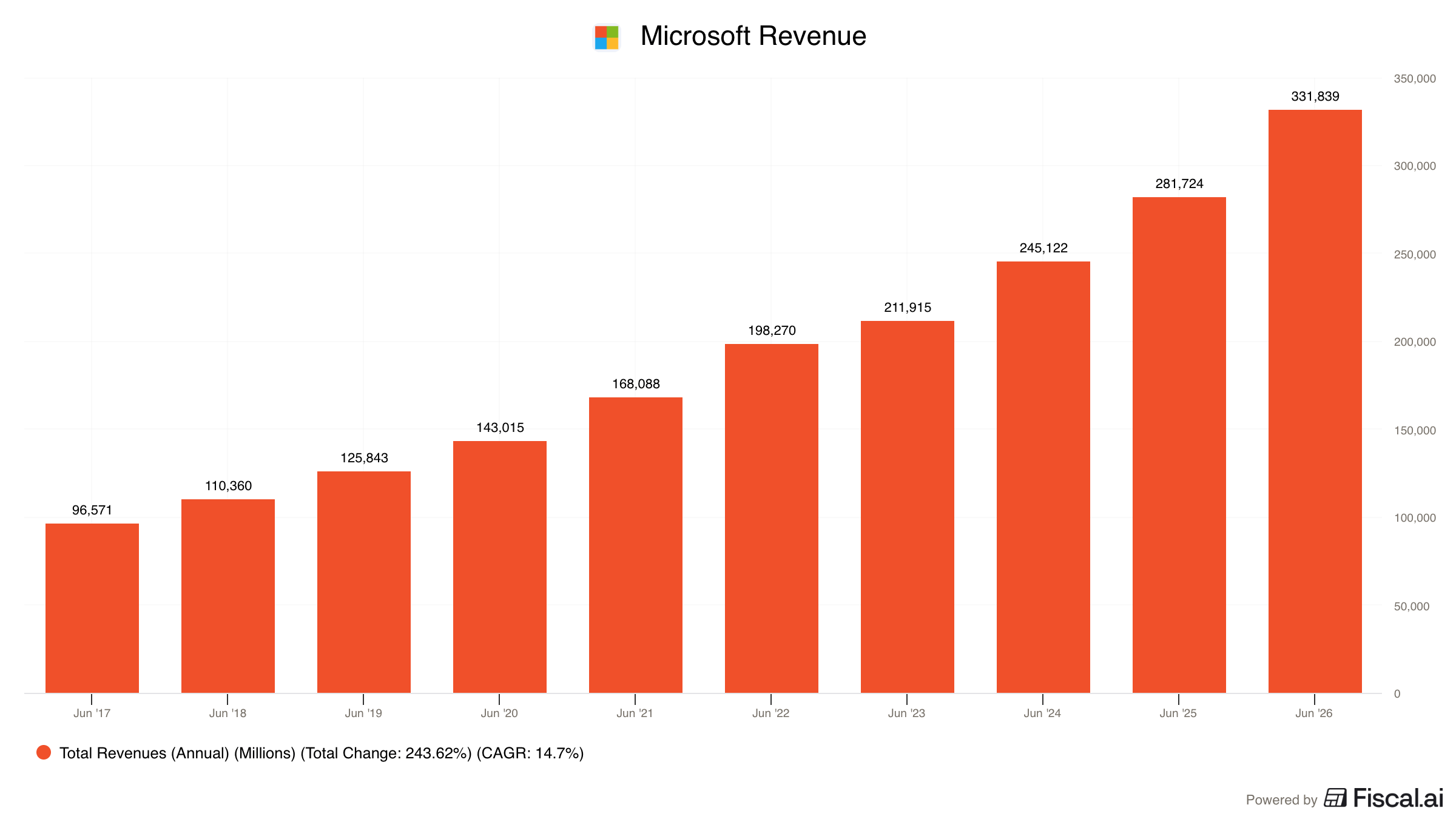
Generating an ordinary 15% return on capital at a healthy 20% net margin requires $1.875 trillion in incremental AI revenues by 2030
To put $1.875 trillion in perspective, that’s six Microsofts.
The hyperscalers have been extending their server and GPU useful lives over the past few years.
Here’s a summary table of the changes, and the effect on profits:
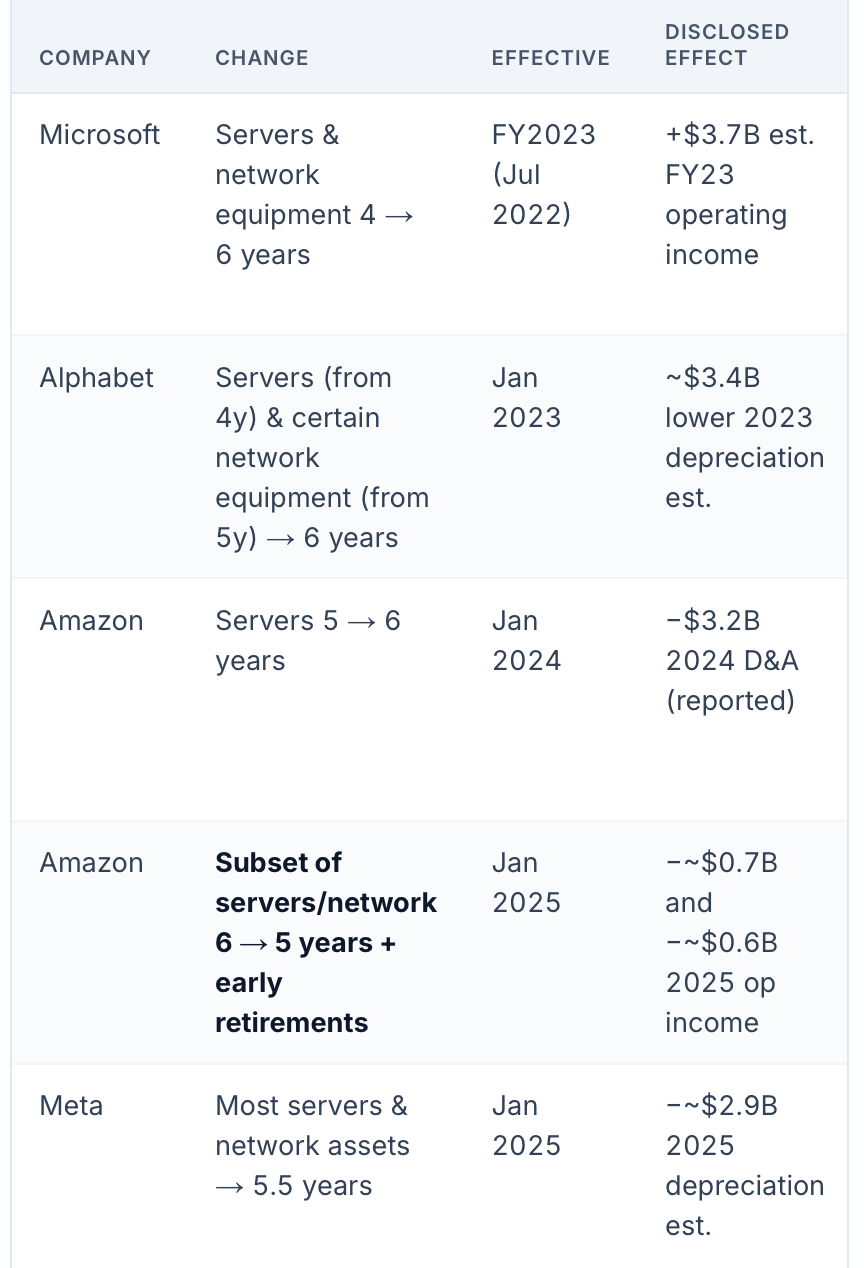
The companies argue that technological advancements have made this equipment useful for longer.
Maybe that’s true, but I find it hard to believe that Nvidia rolling out a new, faster, better chip each year makes the old chips, servers and equipment useful for longer.
Of course, these changes also have the effect of kicking the depreciation can down the road just a bit further.
Notable in the table is that Amazon extended the useful life of servers from 5 years to 6 in 2024, then pulled a subset of them back to 5 years the very next year.
A Different Business
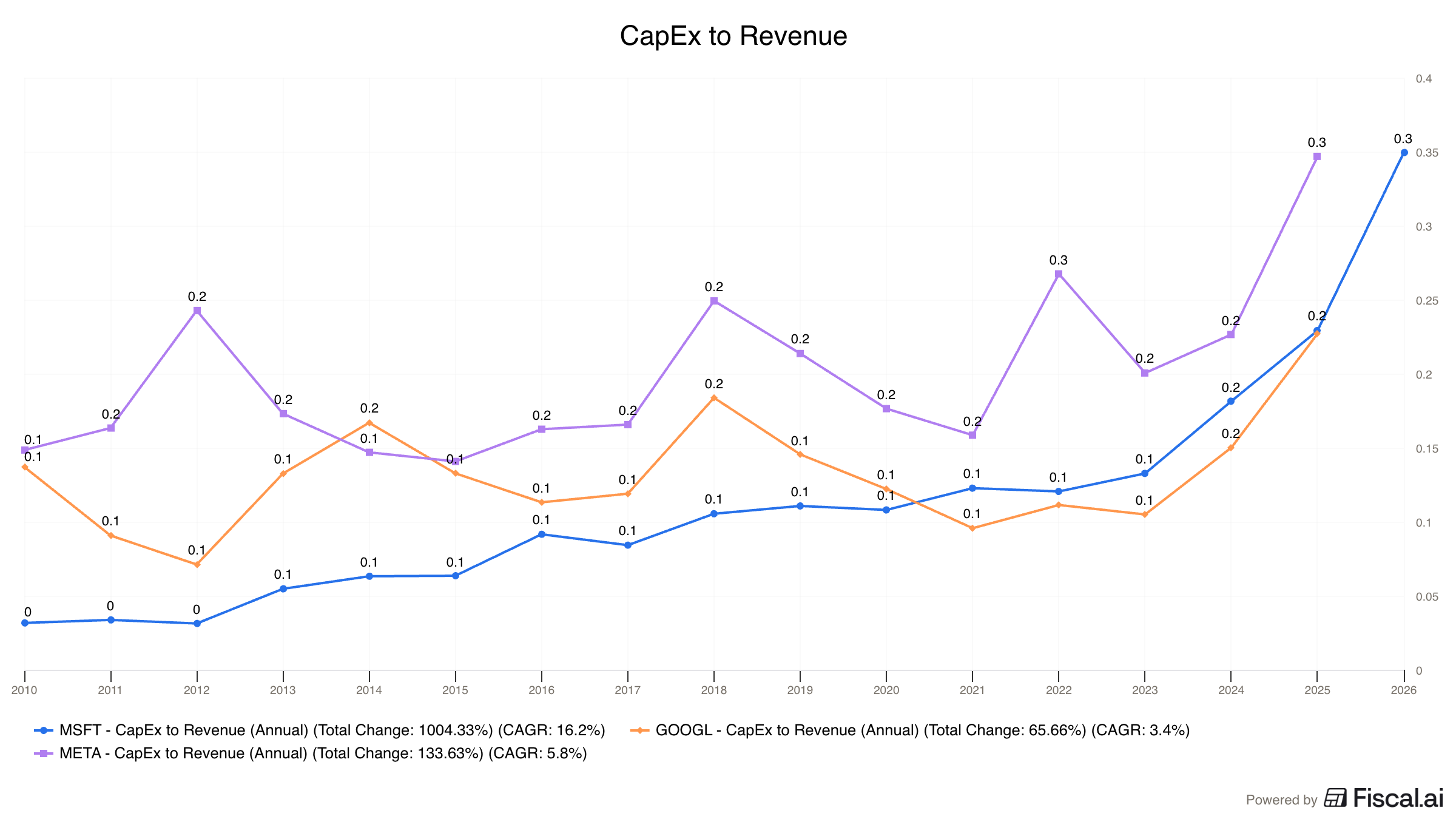
For year, companies like Google, Meta, and Microsoft were asset-light cash cows.
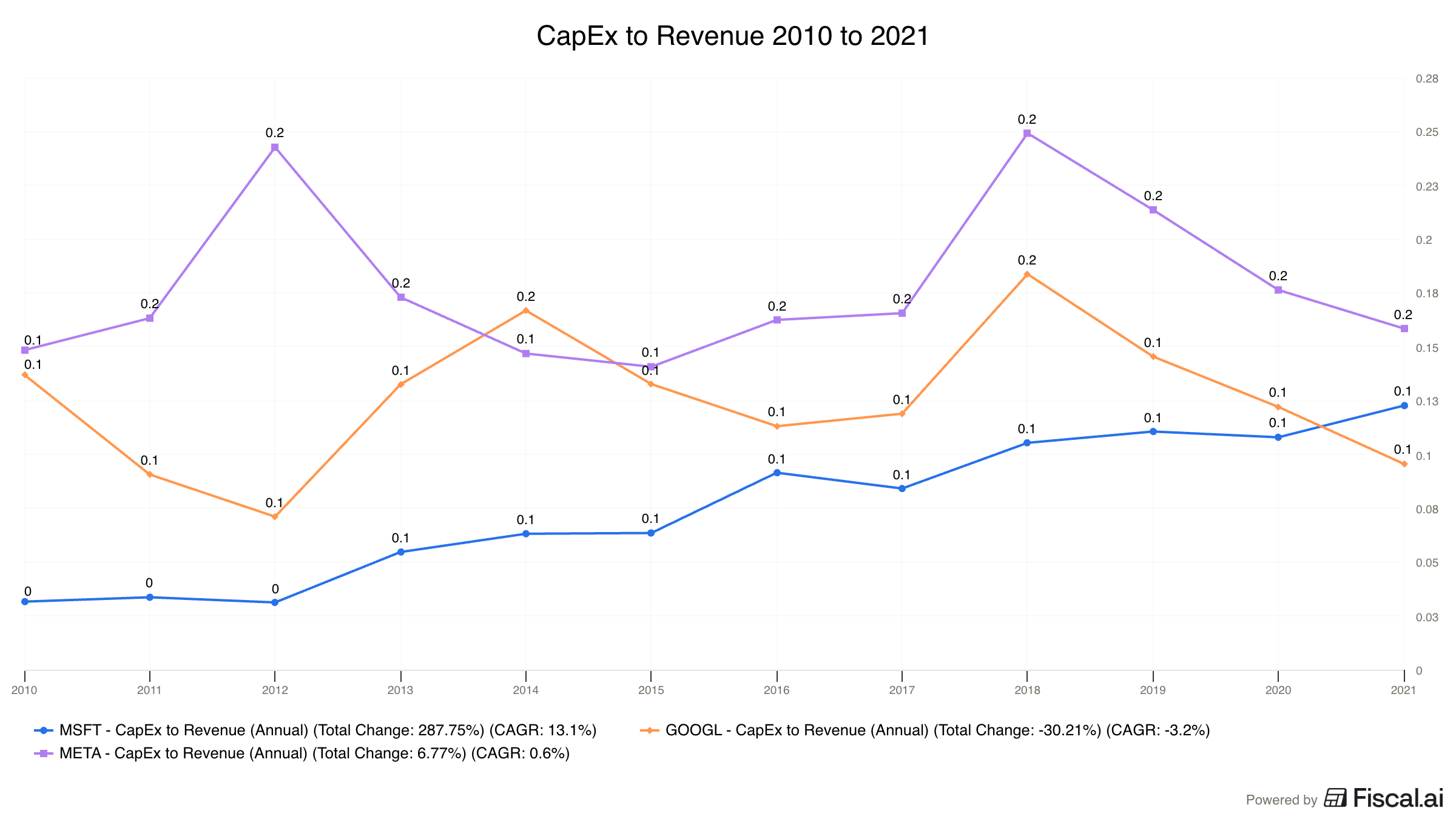
But AI capex is ramping as a percentage of their revenue.
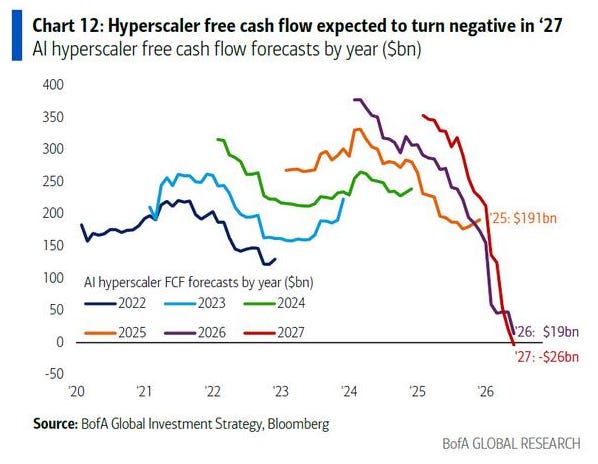
They’re expected to spend nearly all of their Free Cash Flow this year, and be FCF negative in 2027.
These are also companies that have historically spent heavily on repurchasing their own shares.
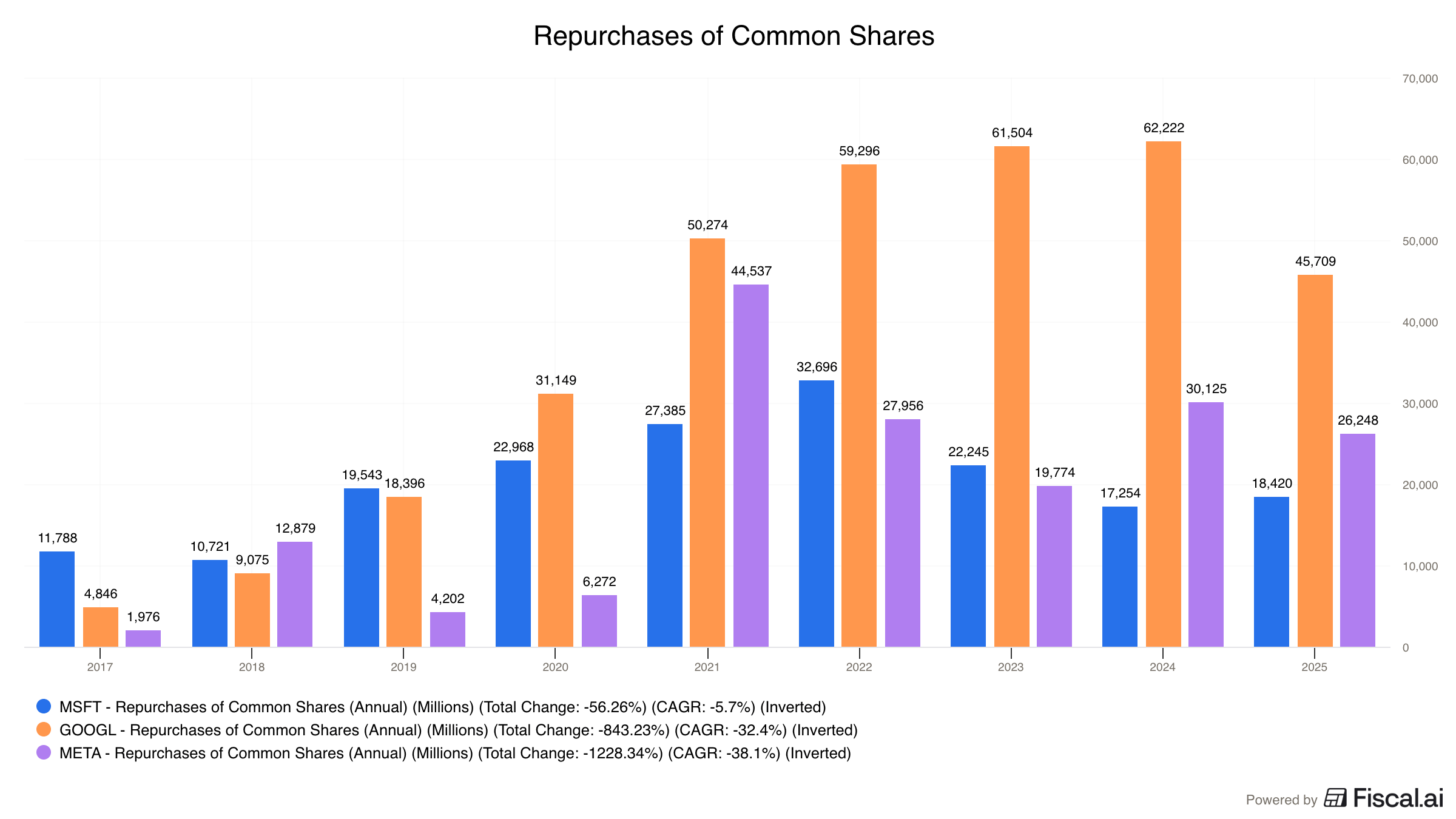
With all the FCF going towards AI CapEx, they won’t be able to do that anymore.
These companies also all pay a dividend - Google and Meta only initiated theirs in the past few years, but Microsoft is a Dividend Aristocrat.
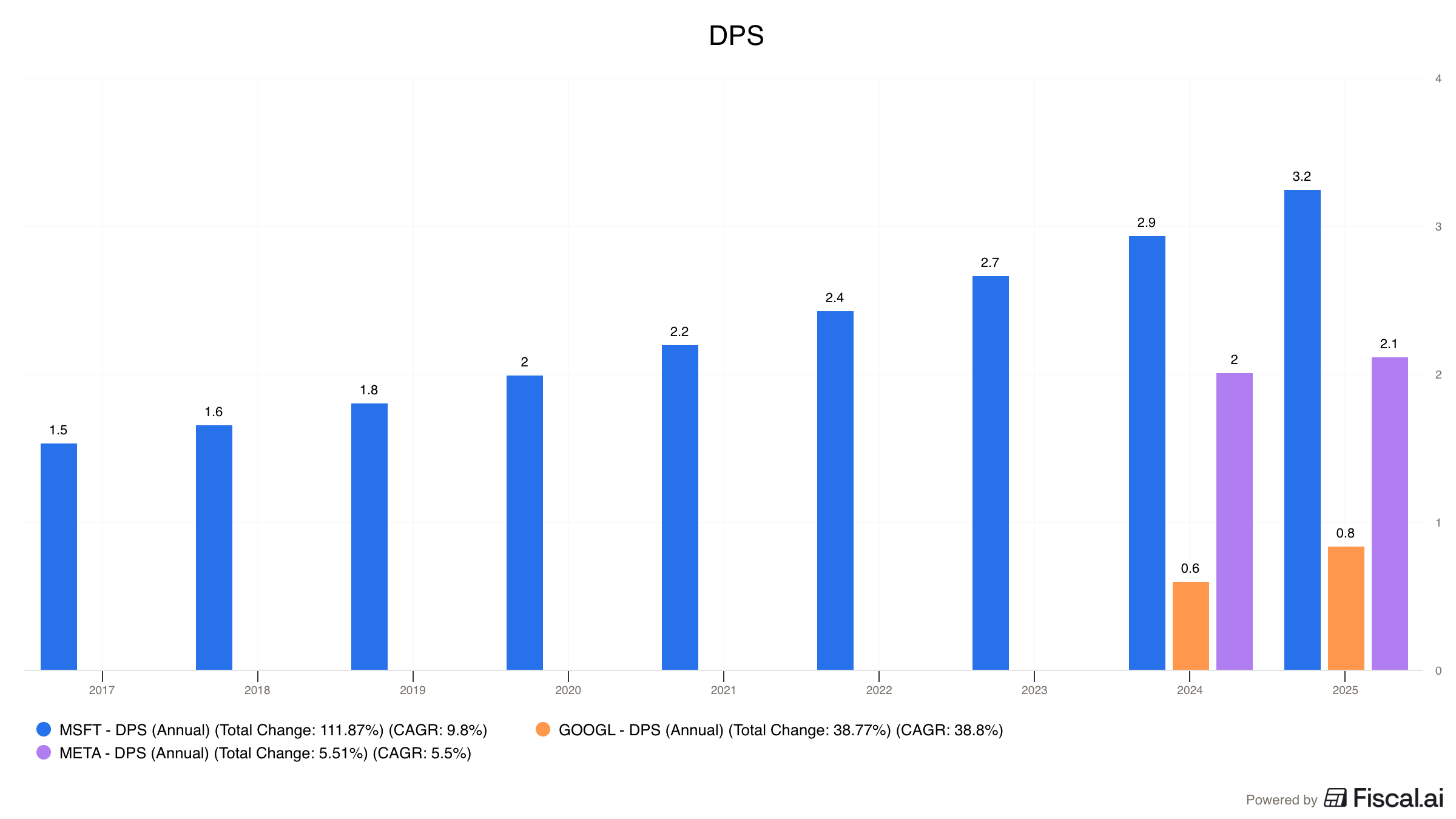
Think about what ‘winning’ this race means - you get to go from a low CapEx and high FCF margin business to a business that likely has lower margins and requires lots of maintenance CapEx.
But they all believe that AI is an existential threat to their own business models and that they have to be the ones to build it out to survive.
The Prisoner’s Dilemma
The AI race is the classic prisoner’s dilemma in corporate form.
The typical framing goes like this: two guilty criminals are interrogated in separate rooms:
If both stay silent, they each get a 1-year sentence.
If one betrays the other and the other stays silent, the betrayer goes free while the silent one gets 20 years.
If both betray each other, they each get 5 years.
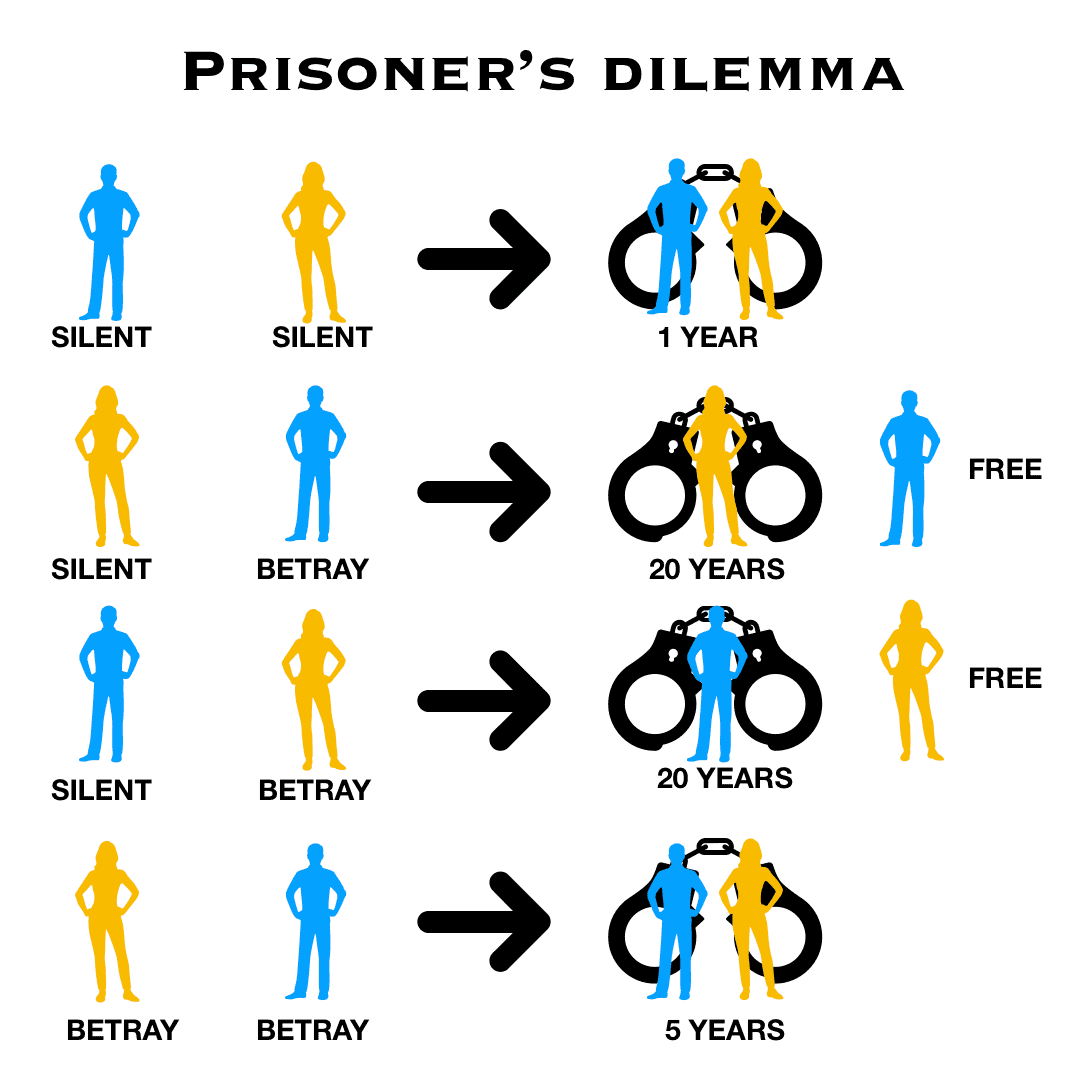
Because neither wants to risk the 20-year sentence, the most rational individual choice is to betray the other.
But because both make this ‘rational’ choice, they both receive 5 years, a much worse collective outcome than if they had just trusted each other and stayed silent.
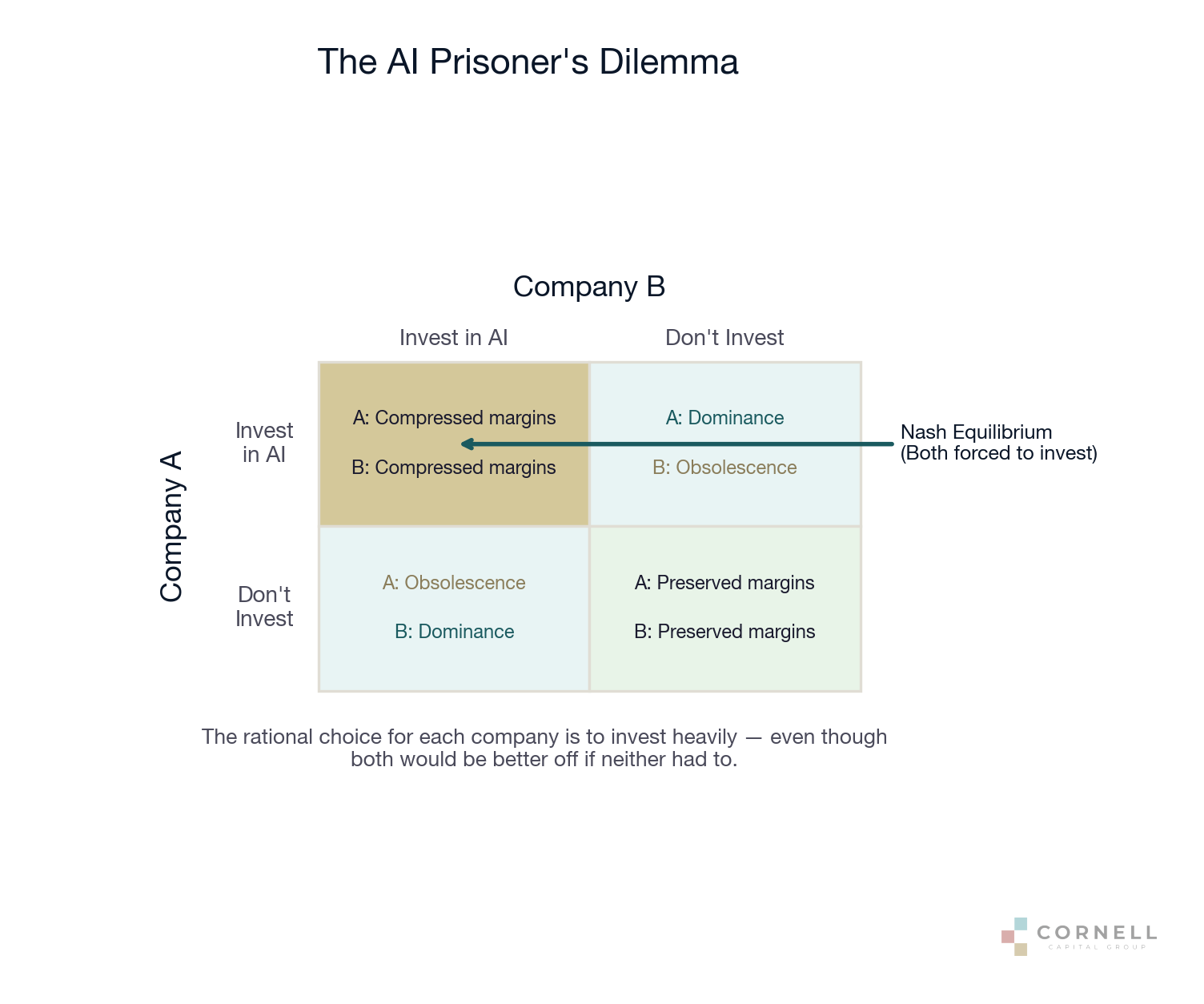
AI is the exact same thing.
If nobody invests in AI, then the companies go on making lots of money on fat margins.
But if one company invests in AI and the other doesn’t the risk for not investing is obsolescence.
When the hyperscalers all invest in AI and compete, it creates a worse business for everyone.
Conclusion
Big Tech is trapped.
They’re in a race where the only way to “win” is to burn their own free cash flow.
We’re watching capital-light cash machines turn into capital-intensive industrials.
There’s an obvious question this should raise.
If these companies are going to spend all of their free cash flow plus more on infrastructure over the next few years where is the money actually coming from?
In Part 3, we’ll look at how the AI buildout is being financed.
See you in Part 3
-TJ
Used sources
Interactive Brokers: Portfolio data and executing all transactions
Fiscal.ai: Financial data
Disclaimer
As a reader of Compounding Dividends, you agree with our disclaimer. You can read the full disclaimer here.